
Ortho-K (orthokeratology) uses custom-designed lenses worn while you sleep. They gently reshape the front surface of the eye overnight, so you can take them out in the morning and see clearly all day. For many children, ortho-k can also help slow how quickly nearsightedness gets worse.
Ortho-K lenses are rigid, breathable contact lenses designed from detailed measurements of your eye. Worn overnight, they apply gentle, even pressure that flattens the centre of the cornea by a tiny amount, which corrects nearsightedness (myopia) and some astigmatism.
The effect is temporary and reversible. Most people wear their lenses every night to keep their vision clear the next day. If you stop wearing them, your eyes gradually return to their original shape, usually within a few days to a couple of weeks.
People sometimes call them "eye retainers," which is a good way to think about it: like a dental retainer, they hold a shape while you sleep.
Nearsightedness usually develops in childhood and tends to get worse as the eye grows longer. The faster it progresses, the higher the risk of eye problems later in life, such as retinal detachment, myopic maculopathy and glaucoma.
Research has found that ortho-k can slow the rate at which a child's eye grows longer, compared with regular glasses or contact lenses. Results vary from child to child, which is why we measure progress closely.
We track axial length (the length of the eye) with optical biometry, not just your prescription. It's the most direct way to see whether myopia control is working.
Myopia control glasses, MiSight daily contact lenses and low-dose atropine drops are also effective. Sometimes a combination works best. We'll talk through what fits your child.
Ortho-K works well for many people, but not everyone. A consultation is the only way to know for sure.
If ortho-k isn't right, there are other good options, and we'll tell you honestly which one we'd recommend.
Ortho-K is a process, not a one-time fitting. Here's what the first few months typically look like.
A full eye health check, plus corneal topography (a detailed map of the front of your eye) and axial length measurement. We'll talk about whether ortho-k suits you, what to expect, and the costs involved.
Your lenses are designed from your measurements and made to order. Every eye is different, so no two pairs are the same.
We check the fit, then teach you (or you and your child) how to put lenses in, take them out and clean them. You'll go home only once you're comfortable.
You come in wearing your lenses after the first night so we can check how they've settled and how your vision and cornea are responding.
Most people see clearly within the first one to two weeks. If the fit needs adjusting, we redesign the lenses during this period.
Visits every six months or so to check eye health and lens condition and, for children, to measure axial length and track myopia progression. Lenses are usually replaced about once a year.
Ortho-K has been used for decades and is considered safe when lenses are fitted carefully and looked after properly. Like any contact lens worn overnight, it carries a small risk of eye infection, which can be serious. Nearly all of that risk comes down to hygiene, so we spend time making sure you know exactly what to do.
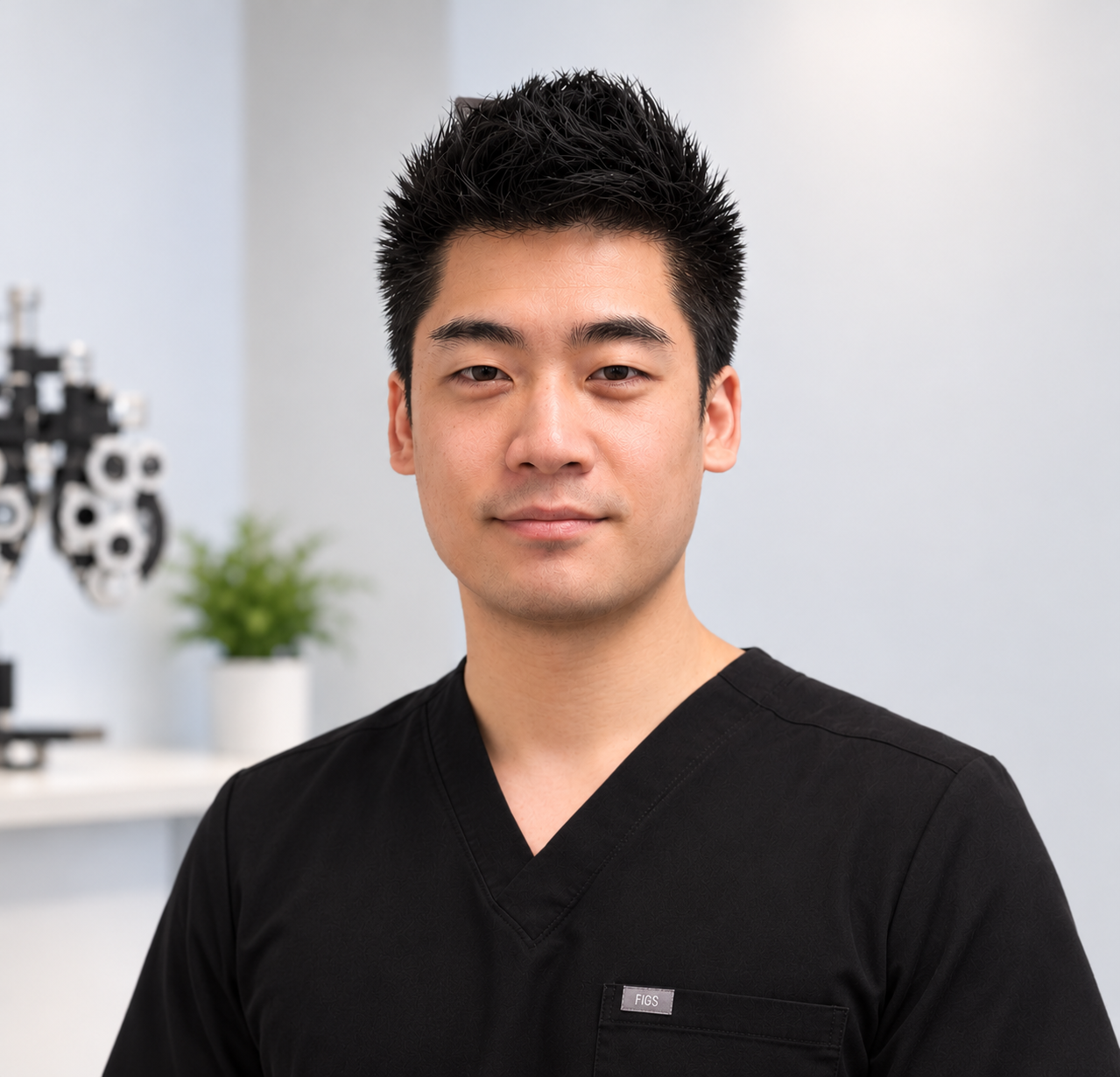
Dr. Huang is an optometrist practising in Markham and Toronto, with a special interest in orthokeratology and myopia control.
Before entering optometry, he worked for five years as a licensed optician, fitting eyeglasses and contact lenses. His work with ortho-k began in 2011 during that time, and has continued since he earned his Doctor of Optometry from the New England College of Optometry in 2020. Today he designs and fits ortho-k lenses directly, along with RGP and scleral lenses for patients with keratoconus, irregular corneas and other conditions that glasses or soft lenses don't correct well.
He provides care in English and Cantonese, and makes a point of making sure patients and parents understand their options and the reasoning behind each recommendation.
More about Dr. HuangOrtho-K is a custom treatment, so fees cover more than the lenses. We'll go through the costs at your consultation, before anything is ordered.
$50
$2500 Includes the custom lenses, fitting, training Axial length and follow-up visits in the first year, plus any lens redesigns or remakes.
$1250 Covers replacement lenses and regular check-ups, including axial length tracking for children.
Many extended health plans cover part of the cost under vision or contact lens benefits. We're happy to provide receipts and details for your claim.
There's no fixed minimum age. Many children start successfully around 7 or 8, and some younger. What matters more is whether the child is comfortable with lenses and whether a parent can help with nightly care.
Most people notice a big improvement after the first night, and reach stable, clear vision within one to two weeks. Glasses or daily disposable lenses may be needed for part of the day during that first week or two.
Ortho-K lenses are rigid, so there is an adjustment period, but because they're worn with the eyes closed most people find them comfortable after the first few nights.
It can correct low to moderate astigmatism, and there are lens designs made specifically for it. Whether it suits you depends on your measurements, which we check at the consultation.
Vision gradually returns to the original prescription over days to a couple of weeks, and the myopia control effect stops. There's no lasting harm, but stopping and starting can make it harder to judge progress, so we'd usually discuss switching to another myopia control option instead.
No. Adults use ortho-k too, usually to be free of glasses and daytime contacts. For adults, the main goal is clear vision rather than myopia control.
Many extended health plans cover part of the cost under vision or contact lens benefits. Coverage varies, so check your plan, and we'll provide what you need to submit a claim.
Consultations are available at our Markham clinic.
Elevate Vision Care
Unit 4 – 7357 Woodbine Ave, Markham, ON L3R 1A7
(905) 940-8834


